Using this Guide
Reading Entries
Each entry in this guide corresponds to a unique morphospecies.
A morphospecies is a species assignment based on the appearance of the specimen. In our lab, we assigned morphospecies based on both the appearance of the spider and the spiderweb. Our morphospecies codes consist of the lowest taxonomic rank determined for the species, along with a unique number for each morphospecies. For example, if we have three Cyclosa spiders that look different from each other, we will assign them the morphospecies ‘cyclosa.sp1,’ ‘cyclosa.sp2,’ and ‘cyclosa.sp3.’ If we have two Anapis spiders that look identical, we will assign them both the morphospecies ‘anapis.sp1.’
Web Type:
Which kind of web the spider builds. Either orb, tangle, or sheet-tangle.

Refuge:
Whether or not the spider builds a protective structure beside/on the web.
Spider Pictures

spider.sp1

2019.NRP.W7.14
2019.NRP.W7.14
Black-coloured spherical abdomen, with eight legs. Black-coloured cephalothorax. Black legs, chelicerae, eyes, and pedipalps. Leg 4 is much longer than other legs.
Locations: Place, Area, Country (elevation); Place, Area, Country (elevation)

YYYY.LLL.W0.00

YYYY.LLL.W0.00

YYYY.LLL.W0.00, YYY.LLL.W0.00, YYYY.LLL.W0.00, YYYY.LLL.W0.00, YYYY.LLL.W0.00
Description:
Detailed description of the appearance for members of the morphospecies.
Locations:
Places we have found spiders of this morphospecies.
Spider #
Year
YYYY.LLL.W0.00
Location
Transect #
Spider Codes:
The codes of spiders we have found of this morphospecies.
Taxonomy:
Here, the order, family, and genus of the morphospecies is provided. Sometimes, we do not know the family or genus, so those sections will remain blank. Clicking the box with order, family, or genus will take you to that page. All families are listed on the Araneae page.
Understanding Descriptions
The descriptions of morphospecies entries often contain terminology specific to spiders. In this section is a crash course on basic spider anatomy, as well as provide a glossary of terms.
Spinnerets
Dorsal View:
Abdomen
Cephalothorax

Pedipalp
Palpal Bulb (Males)
Chelicerae
Fangs
Femur
Patella
Tibia
Tarsus & Metatarsus
Claws
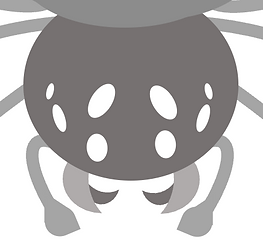
Posterior Median Eye
Posterior Lateral Eye
Anterior Lateral Eye
Anterior Median Eye
Ventral View:

Epigynum (Females)
Coxa
Glossary
Term | Definition |
|---|---|
Patella | The fourth leg segment, or knee, attached to the femur and tibia. |
Pedicel | A structure that connects the abdomen to the cephalothorax. |
Pedipalp | Thin, elongated appendages used for taste and smell, located at the front of the cephalothorax. They are attatched to palpal bulbs in male spiders. |
Posterior Lateral Eyes | The pair of eyes on the back side edge of the cephalothorax. |
Posterior Median Eyes | The pair of eyes on the back middle of the cephalothorax. |
Refuge | A protective structure the spider builds or brings onto its web, to shield itself from predators. For example, a curled leaf, a silken funnel, or a decoy exoskeleton. |
Sheet-Tangle Web | A 3-dimensional web consisting of a basket, dome, or sheet of silk, accompanied by a loose tangle of silk. They are build by some spiders (e.g., Kapogea, Litoporus, Mecolaesthus). |
Silk | An organic fibre spun by spiders to build their webs |
Spinneret | An external organ used for spinning silk, located on the abdomen tip or on the ventral side of the abdomen. |
Stabilimentum | A silken web decoration built by spider, potentially used to lure prey through reflecting ultraviolet light or camoflague the spider (i.e., act as a refuge). Examples of stabilimenta shapes include a spiral, X-mark, oval, or zig zag. |
Sternum | The bottom side of the cephalothorax |
Tangle Web | A 3-dimensional web of loose silk strands build by some spiders (e.g., Architis, Argyrodes, Chrysso). |